Hit the Podcast if No Time to Read the Blog
The New Digital Marketing Frontier
Remember when having a simple website and posting occasionally on social media was enough to be considered “digitally savvy”? Those days are long gone. In 2025, small businesses are navigating a completely transformed digital landscape one where AI agents are no longer optional but essential tools for staying competitive.
At Mixed Media Ventures, we’ve watched this evolution happen in real time, helping hundreds of small businesses adapt to these technological shifts. What’s different now is the accessibility and sophistication of AI tools that were once available only to enterprises with massive budgets.
“The democratization of AI technology has fundamentally altered the playing field,” says Dr. Maya Patel, Digital Transformation Specialist. “Small businesses with minimal technical expertise can now deploy AI agents that perform complex marketing functions at a fraction of the cost of hiring additional staff.”
Let’s explore how these AI agents are revolutionizing digital marketing for small businesses and why 2025 marks a turning point in adoption and implementation.
What Exactly Are AI Agents?
Before diving deeper, let’s clarify what we mean by “AI agents” in 2025. Unlike basic automation tools of the past, today’s AI agents are sophisticated systems that can:
- Execute multi step workflows autonomously
- Make contextual decisions based on real time data
- Learn and improve from interactions over time
- Integrate seamlessly with existing business systems
- Communicate naturally with both customers and team members
These aren’t just chatbots or simple if then automation sequences. Modern AI agents function more like virtual team members capable of handling complex tasks and adapting to changing circumstances without constant human oversight.
The 5 Game Changing Ways AI Agents Are Transforming Small Business Marketing
1. Hyper Personalization at Scale
One of the most significant impacts of AI agents is their ability to deliver personalized experiences to every customer without requiring an army of marketers.
Today’s AI systems analyze thousands of customer data points including browsing behavior, purchase history, demographic information, and even real time engagement signals to create truly personalized marketing experiences.
For small businesses, this means:
- Dynamic website content that changes based on visitor attributes and behaviors
- Intelligent email campaigns that automatically adjust messaging, timing, and offers for each recipient
- Personalized social media interactions that respond to individual engagement patterns
- Customized product recommendations that significantly improve conversion rates
A local boutique in Las Vegas implemented our voice AI solution and saw a 34% increase in repeat purchases by delivering perfectly timed, personalized communications that felt like they came from a dedicated personal shopper despite having just three employees.
2. Predictive Analytics and Strategic Decision Making
Small businesses have traditionally been at a disadvantage when it comes to data analytics, lacking the resources for dedicated data teams or expensive analytics platforms.
AI agents have changed this equation dramatically. Today’s small business owners use AI powered analytics to:
- Forecast seasonal demand fluctuations with remarkable accuracy
- Identify emerging market trends before competitors
- Optimize pricing strategies in real time
- Predict customer churn and proactively address at risk relationships
- Allocate marketing budgets to channels with the highest predicted ROI
A family owned business in South Florida used our predictive analytics tools to anticipate a shift in customer demographics three months before it became apparent through traditional metrics. This foresight allowed them to adjust their messaging and product mix proactively, maintaining growth while competitors struggled to adapt.
3. End to End Workflow Automation
Perhaps the most transformative aspect of AI agents is their ability to execute complex, multi step marketing workflows without human intervention.
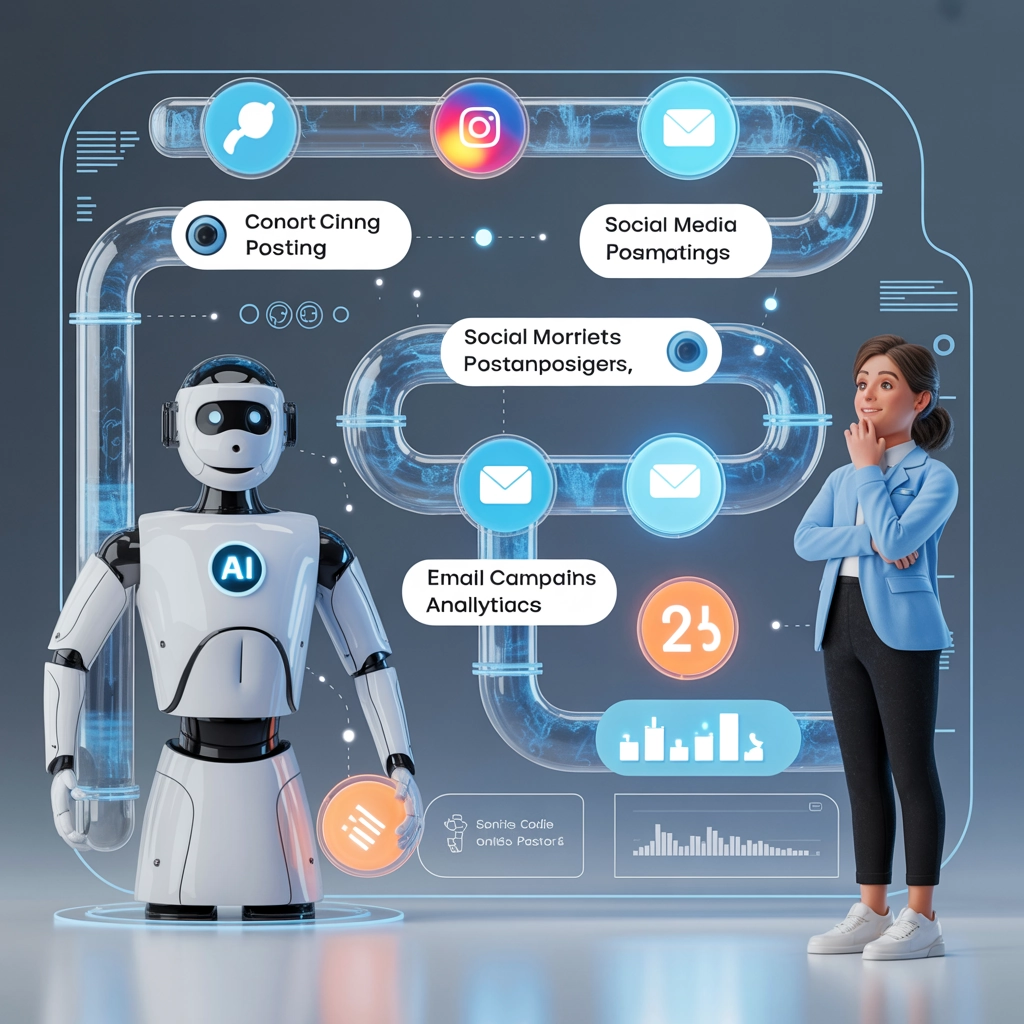
In 2025, AI agents handle entire marketing processes like:
- Content planning, creation, and distribution: Generating topic ideas based on trending keywords, drafting content, optimizing for SEO, scheduling posts, and analyzing performance
- Ad campaign management: Creating ad variations, allocating budget across platforms, adjusting bids in real time, and optimizing creative elements based on performance
- Lead nurturing sequences: Qualifying leads, personalizing follow up communications, scheduling appointments, and preparing briefing materials for sales conversations
- Competitive intelligence: Monitoring competitor activities, analyzing pricing changes, tracking new offerings, and providing actionable insights
“The most valuable aspect of AI agents for our business isn’t just the time savings it’s the consistency,” says Jamie Rodriguez, owner of a growing consulting firm in New Jersey. “Our marketing never falls through the cracks anymore, even during our busiest seasons.”
4. Conversational Marketing That Never Sleeps
Customer expectations for immediate, helpful responses have never been higher. AI agents excel at maintaining conversational relationships with prospects and customers across multiple channels 24/7.
Modern AI conversational agents can:
- Handle complex customer service inquiries with natural language understanding
- Qualify leads through intelligent questioning
- Guide customers through purchase decisions
- Proactively reach out when behavioral triggers indicate sales opportunities
- Seamlessly transition complex conversations to human team members when necessary
The key difference in 2025 is how natural these interactions have become. Most customers can’t distinguish between AI and human responses, creating a seamless experience that builds brand trust.
A senior care service provider we work with implemented conversational AI on their website and saw inquiry to consultation conversion rates increase by 67% while reducing response time from hours to seconds. This implementation was part of a comprehensive senior care digital marketing strategy.
5. Content Creation and Optimization Revolution
Content creation has historically been a significant bottleneck for small businesses. Limited resources often meant choosing between quantity and quality. AI agents have fundamentally changed this equation.
Today’s AI content systems can:
- Generate long form blog articles optimized for specific keywords and reader intent
- Create variations of ad copy for different platforms and audience segments
- Produce video scripts and social media captions
- Automatically localize content for different regional markets
- Continuously optimize existing content based on performance data
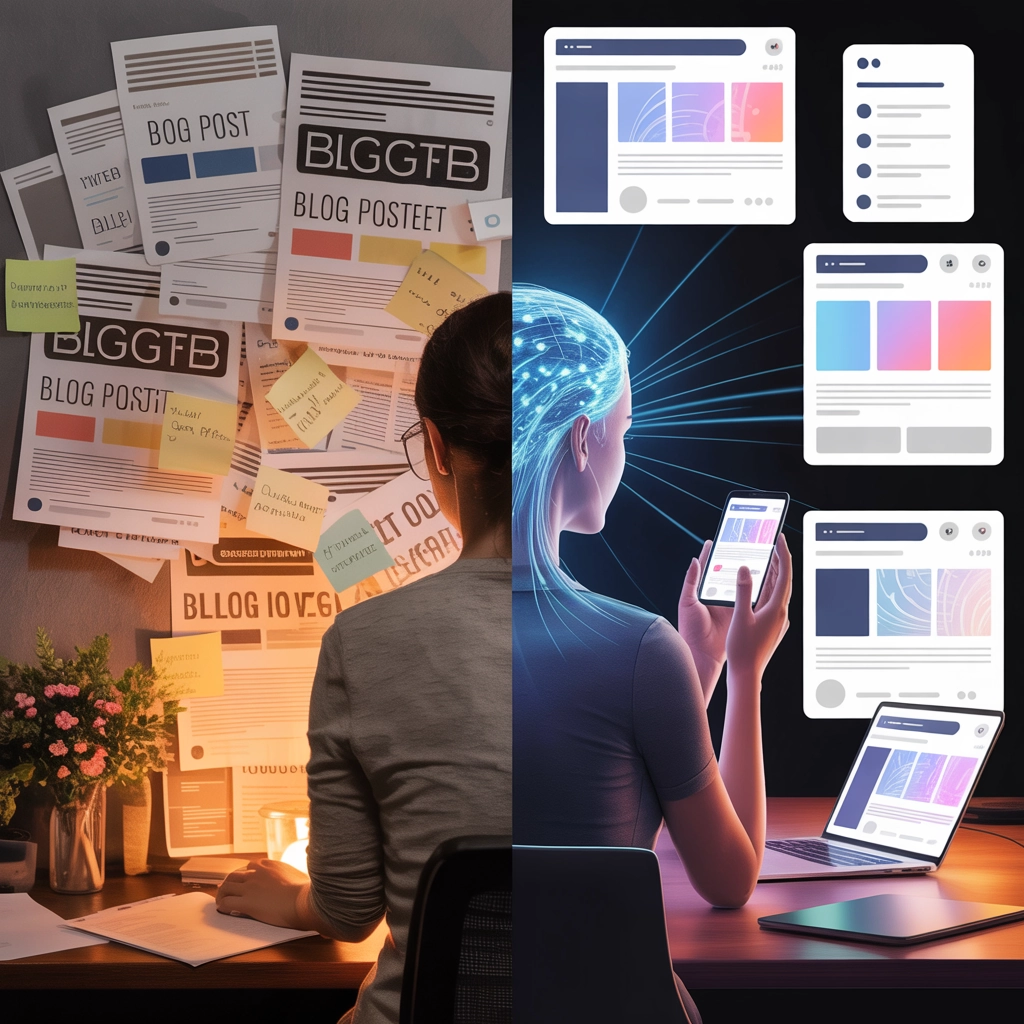
The result? Small businesses can maintain robust content calendars across multiple channels without sacrificing quality or strategic alignment.
“We used to publish maybe one blog post monthly. Now our AI assisted content system helps us maintain three weekly posts plus daily social content all with just a few hours of human oversight,” explains Michael Chen, whose e commerce business saw organic traffic increase 215% after implementing an AI content strategy.
Implementation Strategy: How to Get Started
The gap between businesses leveraging AI agents and those relying on traditional methods is widening rapidly. If you’re just beginning your AI implementation journey, here’s a practical roadmap:
1. Audit Your Current Marketing Processes
Start by identifying:
- Tasks that consume disproportionate time relative to their impact
- Repetitive processes that follow predictable patterns
- Areas where personalization would significantly improve results
- Existing bottlenecks in your marketing workflow
2. Prioritize Implementation Areas
Not all AI applications deliver equal value. We recommend most small businesses start with:
- Customer service automation (highest immediate ROI)
- Basic content generation and optimization
- Social media management and engagement
- Email personalization and campaign optimization
3. Choose the Right Technology Partners
When selecting AI marketing solutions, consider:
- Integration capabilities with your existing tech stack
- Scalability as your needs grow
- Training requirements and learning curve
- Ongoing support and development roadmap
At Mixed Media Ventures, we help businesses navigate these decisions through our competitive analysis service, ensuring you select technologies that align with your specific business needs.
4. Start Small, Measure Results, and Scale
Begin with a single, well defined use case:
- Implement the solution
- Establish clear metrics for success
- Analyze results against pre implementation benchmarks
- Use insights to refine and expand to additional areas
5. Prioritize Human AI Collaboration
The most successful implementations focus on:
- Redeploying human talent to high value creative and strategic activities
- Establishing clear oversight processes for AI outputs
- Creating feedback loops to continuously improve AI performance
- Maintaining the human touch in key relationship moments

Overcoming Implementation Challenges
Despite the clear benefits, many small businesses face challenges when adopting AI marketing agents. Here are common obstacles and solutions:
Data Quality and Integration Issues
Challenge: AI systems require clean, accessible data to perform effectively.
Solution: Begin with a data audit and cleanup process before implementation. Consider using database reactivation services to maximize the value of existing customer information.
Team Resistance and Skill Gaps
Challenge: Employees may resist technology they perceive as threatening their roles.
Solution: Frame AI implementation as augmentation rather than replacement. Invest in training and highlight how automation frees team members for more rewarding work.
Budget Constraints
Challenge: Initial implementation costs can seem prohibitive.
Solution: Start with solutions offering flexible pricing models and clear ROI tracking. Most businesses find that AI marketing agents become cost positive within 3 – 6 months.
Ethical and Privacy Considerations
Challenge: Customer data usage raises important ethical questions.
Solution: Prioritize transparency in your AI implementation. Clearly communicate data usage policies and ensure compliance with regulations like GDPR and CCPA.
The Future: Where Small Business AI Marketing Is Headed
Looking beyond 2025, several emerging trends will further transform how small businesses approach marketing:
- Multimodal AI agents that seamlessly work across text, voice, image, and video
- Ambient intelligence that integrates physical and digital customer experiences
- Autonomous marketing systems that set and adjust their own performance goals
- Collaborative AI networks that share insights across business boundaries while protecting proprietary data
For small businesses, the message is clear: implementing AI marketing agents isn’t just about keeping up it’s about laying the foundation for long term competitive advantage in an increasingly automated marketplace.
Taking the Next Step
The AI revolution in marketing isn’t coming it’s here. Small businesses that embrace these technologies gain significant advantages in efficiency, personalization, and customer engagement.
At Mixed Media Ventures, we’ve helped businesses across New York City, Las Vegas, and beyond implement AI marketing solutions tailored to their specific needs and goals.
Are you ready to explore how AI agents can transform your marketing efforts? Our team offers comprehensive assessments to identify your highest impact opportunities.
Contact our team for a personalized consultation, or explore our CMO services for strategic guidance on implementing AI marketing solutions that deliver measurable results.
The question isn’t whether AI will transform your marketing it’s whether you’ll be ahead of the curve or playing catch up.