
Quick Summary
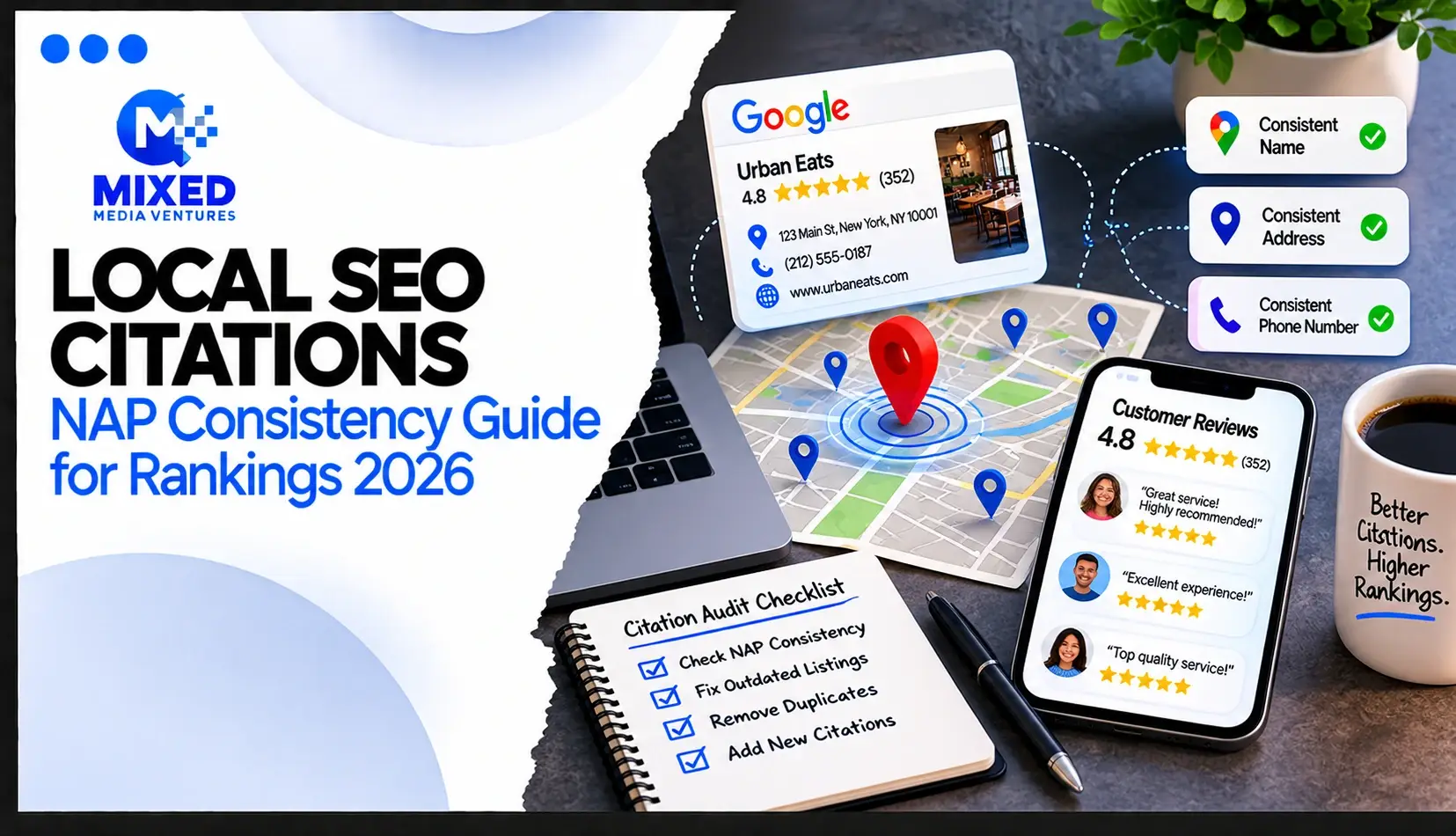
Local SEO citations are online mentions of a business’s Name, Address, and Phone number (NAP) across directories, data aggregators, and industry websites, and they function as one of the clearest trust signals Google uses to confirm that a local business is real, active, and located where it claims to be. When NAP data stays identical across every listing, from Google Business Profile to smaller niche directories, local citations compound into a strong, verifiable local presence that supports higher map pack rankings and organic visibility. When that data drifts out of sync, even through something as small as an outdated suite number or an old phone line, local SEO citations start working against a business instead of for it, diluting the same trust signal that consistent listings would otherwise build. For growing businesses managing multiple locations or service areas, particularly across competitive markets like New Jersey, New York, Las Vegas, and South Florida, auditing and correcting local citations is one of the fastest, most controllable ways to recover lost local ranking ground and can help resolve conflicting business information, although the timing and ranking impact vary by business, market, and the extent of the inconsistencies.
Why this matters: Citation accuracy is part of the broader local search work we perform for service-based and multi-location businesses. Mixed Media Ventures has supported 200+ businesses and has been building marketing systems since 2013, with experience spanning SEO, digital marketing, CRM, automation, and growth strategy. Our local search work looks beyond individual directory listings to identify inconsistent business information, duplicate profiles, and outdated data that can create problems across a business’s online presence.
Local SEO Citations: What They Are and Why NAP Consistency Matters
A business owner checks their Google Business Profile, sees the address looks right, and assumes local SEO is handled. Meanwhile, an old Yelp listing still shows a previous suite number, a Yellow Pages entry abbreviates the business name differently, and a data aggregator somewhere is quietly feeding outdated information to a dozen smaller directories nobody remembers signing up for. This is exactly where it starts quietly working against a business instead of for it, and it’s more common than most business owners realize.
If your rankings have plateaued despite steady content and consistent Google Business Profile updates, the problem may not be your content strategy at all. It may be sitting in directories you haven’t checked in years. This guide breaks down what local SEO citations actually are, why NAP consistency carries so much weight in local search, and exactly how to audit and fix the errors that are likely already costing visibility.
What Are Local SEO Citations, Exactly?
A citation is any online mention of a business’s Name, Address, and Phone number, commonly shortened to NAP, whether or not that mention includes a clickable link back to the website. Local SEO citations live on business directories like Yelp and Bing Places, data aggregators such as Data Axle and Foursquare, chambers of commerce, industry-specific platforms, and sometimes even local news coverage or sponsorship pages.
Search engines treat citations as a verification layer, not just a listing. A single Google Business Profile is relatively easy to set up; dozens of independent, consistent mentions across unrelated sources are much harder to fabricate, which is exactly why local citations carry real weight as a local ranking factor rather than functioning as background noise.
Structured vs. Unstructured Citations
They generally fall into two buckets:
- Structured citations appear in a fixed, labeled format on directory sites; think a Yelp business profile or a chamber of commerce listing where Name, Address, and Phone sit in clearly defined fields.
- Unstructured citations show up in more casual contexts, like a local news article, a community blog post, or a sponsorship page mentioning the business name and location in regular text.
Both types matter, but structured citations on high-authority directories tend to have a more direct, measurable impact on local pack visibility, which is why most citation cleanup work starts there.
Why NAP Consistency Matters for Local Search
NAP consistency means keeping a business’s Name, Address, and Phone number accurate and consistent across important online listings. The goal is not necessarily to make every listing match character for character. What matters more is that search engines and customers can confidently recognize the same business across different sources.
It’s About Accuracy, Not Perfect Formatting
Minor formatting differences do not automatically mean that two listings represent different businesses. For example, one directory might display “123 Main St., Suite 4” while another uses “123 Main Street, #4.” If the underlying business information is accurate and clearly refers to the same business, the formatting difference itself is not necessarily a problem.
The bigger concern is a meaningful discrepancy, such as an outdated address, incorrect phone number, significant business name variation, or duplicate listing. These conflicts can make business information less reliable for customers and create confusion across the local search ecosystem.
Consistency Strengthens Your Business Information
When important listings consistently identify the same business, they create a clearer and more reliable online presence. That is why citation cleanup should focus on correcting meaningful discrepancies and maintaining accurate business information rather than chasing identical punctuation or formatting across every directory.
It Supports Local Search Visibility
Local search visibility depends on multiple signals, including relevance, proximity, prominence, reviews, and the accuracy of business information. Keeping important listings accurate and consistent helps ensure that customers encounter the correct business details wherever they search.
How Citation Inconsistency Happens, Even to Careful Businesses
Most local SEO citation problems build up gradually rather than appearing all at once:
- A business relocates or updates its phone line and remembers to update the website, but not the dozens of directories still carrying the old details.
- Data aggregators sync outdated information faster than most businesses can manually correct it across every downstream platform.
- A rebrand or name change, adding “LLC,” dropping a “The,” or updating a suite number, creates a split between old and new listings instead of one clean update.
- Duplicate listings get created when a business is submitted to the same directory twice, often by different employees or a previous marketing vendor, and both versions stay live indefinitely.
Citation problems rarely exist in isolation. In our work with service-based and multi-location businesses, common issues include outdated phone numbers, duplicate directory profiles, address changes that were never propagated across older listings, and business-name variations created during rebrands. These problems become harder to manage as a company expands into additional locations or service areas, which is why we treat citation accuracy as an ongoing part of local search management rather than a one-time submission task.
How to Audit Your Business’s Local SEO Citations
A citation audit doesn’t require expensive software to start, though dedicated tools speed things up considerably once a business has more than a handful of locations.
- Search the business name directly in Google and note every directory, review platform, and mention that surfaces.
- Check the major data aggregators (Data Axle, Foursquare, Neustar Localeze), since they feed information to dozens of smaller directories automatically.
- Compare every listing against a single source of truth, ideally the Google Business Profile, and flag any variation in name formatting, address, suite number, or phone.
- Identify duplicate listings, which need to be merged or removed rather than simply corrected, since duplicates split ranking signal on their own.
- Prioritize fixes by directory authority, starting with Google, Bing, Apple Maps, Yelp, and Facebook before moving down to niche or industry-specific sites.
Businesses managing multiple service areas, similar to the coordination challenges outlined in our guide to senior living marketing strategies for 2026, often find that citation inconsistencies multiply with each additional location, making a structured audit process essential rather than optional.
How Mixed Media Ventures Approaches a Citation Audit
At Mixed Media Ventures, citation cleanup is treated as part of a broader local search strategy rather than a directory-submission exercise. The process starts by establishing the business’s current information as the reference point, then identifying existing listings, checking for NAP discrepancies and duplicate profiles, and prioritizing corrections across the most relevant platforms. For businesses with multiple locations or service areas, the same process is repeated location by location to prevent inconsistent business information from spreading across the wider search ecosystem.
Building and Maintaining Consistent Local SEO Citations
Once inconsistencies are identified, update each important listing so the business name, address, phone number, and other core details accurately reflect the current business information. Where practical, use a standardized format to make future citation management easier.
From there, new local SEO citations should follow that same standard from day one. A consistent, ongoing citation-building process, rather than a one-time directory submission push, is what compounds into a measurable local ranking advantage over six to twelve months. According to Google’s own guidance on managing Business Profile information, keeping business details accurate and current across the web is directly tied to how confidently the platform surfaces a listing in local results.
This is typically where a structured local SEO program, layered into a broader strategy like the one our team builds through integrated digital marketing services, outperforms businesses handling citations in isolation. Citation work rarely moves the needle alone; it compounds fastest when paired with consistent on-page optimization and review growth.
Local SEO Citations vs. Backlinks: Not the Same Signal
It’s worth separating the two, since they’re frequently confused. A backlink is primarily an authority signal. A citation is primarily a trust and verification signal, and it doesn’t require a link to carry weight. A business can have strong local SEO citations and a relatively thin backlink profile, or the reverse, and the ranking impact of each shows up differently in search results.
Citation accuracy and backlinks serve different purposes in a broader local SEO strategy. Citation work focuses on accurate business information and local relevance, while backlinks can contribute to a website’s broader authority.
Why This Matters More for Multi-Location and Service-Area Businesses
A single-location business has one address to keep consistent. A home services company covering multiple counties, a professional services firm with offices across New Jersey and New York, or a senior living operator managing several communities has to keep local citations accurate across every location simultaneously, which multiplies the risk of drift.
Our team has audited citation profiles for lash studios, law firms, HVAC companies, and multi-location service brands across New Jersey, New York, Las Vegas, and South Florida, and the same three mistakes show up repeatedly: unmerged duplicate listings, mismatched suite numbers after an office move, and outdated phone numbers still live on secondary directories. Catching these early is almost always faster and cheaper than the months of lost visibility that come from ignoring them. For businesses evaluating whether they need dedicated marketing leadership to manage this kind of ongoing local optimization, our breakdown of what a fractional CMO actually does covers how that oversight typically fits into a broader growth strategy.
Final Thoughts
Local SEO citations and NAP consistency rarely get the same attention as content strategy or backlinks, but they remain one of the few local ranking factors a business can fully audit, correct, and see results from relatively fast. An hour spent checking directory listings today can prevent months of diluted rankings caused by nothing more than a mismatched suite number or a disconnected phone line nobody noticed.
If citation cleanup and local ranking strategy feel like more than an internal team has bandwidth for, schedule a free strategy session with Mixed Media Ventures, and we’ll map out exactly where inconsistent local citations are holding back visibility for your business.
FAQs
1. What are local SEO citations?
Online mentions of a business’s Name, Address, and Phone number (NAP) across directories, maps, and other websites, used by search engines to verify a business’s legitimacy and location.
2. What does NAP consistency mean in local SEO?
NAP consistency means keeping a business’s Name, Address, and Phone number accurate and consistent across important online listings, while allowing for minor formatting differences that do not change the underlying business information.
3. How do local SEO citations affect Google rankings?
Consistent citations reinforce Google’s confidence in a business’s legitimacy and location, supporting local map pack and organic local rankings. Inconsistent citations dilute that same trust signal.
4. What’s the difference between a citation and a backlink?
A citation is a NAP mention, with or without a link, that acts as a trust signal. A backlink is primarily an authority signal and doesn’t require NAP data at all.
5. How often should a business audit its local citations?
At minimum, once or twice a year, and immediately after any business change such as a relocation, phone number update, or rebrand.
6. Can duplicate directory listings hurt local rankings?
Yes. Duplicate listings split ranking signals and confuse search engines about which listing is authoritative, so they should be merged or removed rather than left active.
7. Do citations without a website link still help SEO?
Yes. Even unlinked local citations verify business legitimacy and location, supporting local rankings independently of backlink equity.
8. How long does it take to see results from citation cleanup?
There is no fixed timeline. Businesses with significant citation inconsistencies may see changes after important listings are corrected, but the timing and extent of any ranking impact vary by market, competition, business type, and other local SEO factors.
9. Which directories matter most for local SEO citations?
Google Business Profile, Bing Places, Apple Maps, Yelp, and Facebook carry the most weight, followed by major data aggregators like Data Axle and Foursquare.
10. Can a business manage local citations without an agency?
Yes, though it’s time-intensive at scale, especially for multi-location businesses. A structured local SEO program simply speeds up detection and correction across dozens of directories at once.